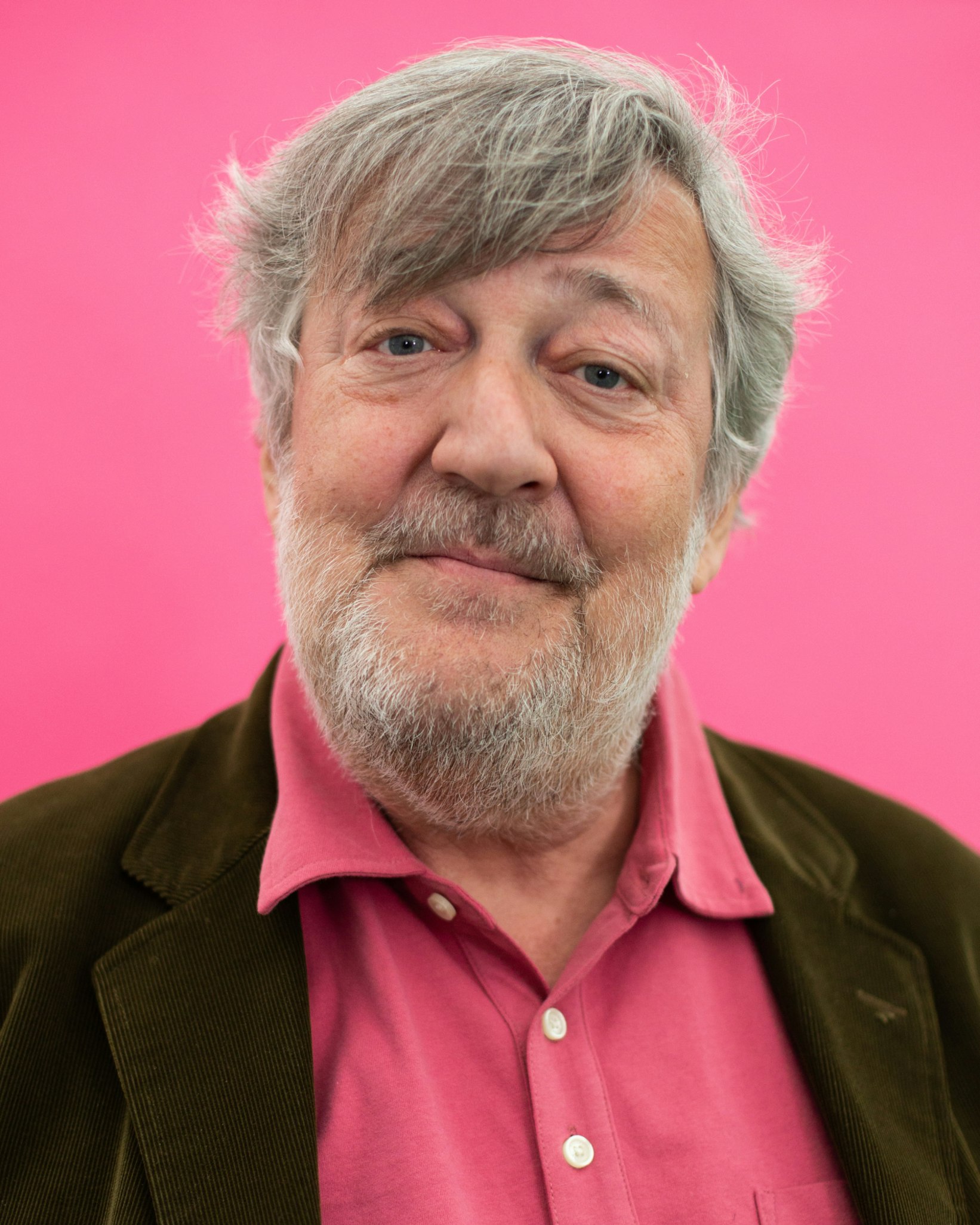
Writer, director, comedian and actor — there’s not much that isn’t in Stephen Fry’s repertoire. As a fellow paper person connected to books and writing his own, we are delighted for him to star in the next chapter of 12 Questions on The Fold. Recently completing the fourth and final instalment of his Greek Myths series Odyssey, we found out his inspirations, favorite reads, and process for putting pen to paper.
What’s the book you always gift to friends?
If I find they haven’t got it, Philip Larkin: Collected Poems. Relatively few in number, but they become richer and more perfect with every encounter. He’s the Vermeer of verse in that respect.
Which book have you reread the most?
Probably Right Ho, Jeeves by P. G. Wodehouse. Solace for times of everything from flu to fractured fibulae.
Which book reminds you of home?
The Go-Between by L. P. Hartley. Captures the Norfolk skies and fields—not to mention the baffling business of childhood.
What are you reading at the moment?
Just finishing The Wide Wide Sea, by Hampton Sides. A beautifully written account of Captain Cook’s third and final voyage. Astonishing.
What are your reading habits like?
Very dependent on work. If I’m travelling (just returned from a tour round Australia and New Zealand), I will take an e-book reader. “Real” books made of atoms weigh too much and take up too much packing space. Electrons don’t have mass (pace the Higgs Boson Field). But at home I tend to leaf through the atomic versions. I read when I can during the day because I usually wake up in the mornings with a book or tablet on my chest cursing myself for falling asleep after the first paragraph.
What is the importance of telling stories?
Interpreting the world, revealing the truths of ourselves and our surroundings. Factual description can only take you so far. We understand what war really is just from Wilfred Owen’s Poems, Remarque’s All Quiet on the Western Front and Tolstoy’s War and Peace—more from those three alone than all the history books ever written. Not that I look down on history or historians, far from it. It’s great for facts, but truth is best revealed in myth, legend, fable and fiction… that’s how it seems to me at least. Mathematics couldn’t achieve much if it didn’t have algebra to provide models and paradigms. Stories are to reality what algebra is to arithmetic. There are no such things as a, or x but by imagining and manipulating them huge pictures of the world can be built.
How would you describe your writing process in five words?
Up very early: keep going.
Which 3 other authors or literary characters would you choose as housemates?
Samuel Johnson (messy but so entertaining and improving). Oscar Wilde (of course: sometimes you have to be obvious). Jeeves (he’d tidy up after Sam and Oscar and keep me looking smart).
What’s something that surprised you when you were working on the Odyssey?
To be reminded of the psychological realism and almost cinematic sense of storytelling that Homer (who they may have been) gave the world. Homer “cuts” backwards and forwards like a director. It’s almost halfway through before we learn of what Odysseus did after leaving Troy. He tells us in first person flashback of the most dazzling kind. But perhaps the most sombre shock came when I heard about the loss of the super yacht Bayesian. News of the tragedy broke just the day after I had first seen and approved of the maps we were to use in the hardback edition of my book, incorporating locations where scholars today believe key episodes in Homer’s Odyssey, Virgil’s Aeneid and other sources took place. We marked Scylla and Charybdis, (the monster on one side and the whirlpool/waterspout on the other) in the Straits of Messina between Sicily and Italy. Exactly the site where a waterspout destroyed the unlucky Bayesian. It seems Homer knew well indeed what the Mediterranean was like.
Apart from the Odyssey, what is your favourite Greek myth?
Perhaps the story of Phaeton and his disastrous attempt to ride his father’s Chariot of the Sun. It combines so much human truth (the truculent son who thinks he’s ready to handle an adult pursuit, the guilty absent father) with the universal and oft repeated Greek mythic theme of the mortal reaching too high and being felled by the immortals for the presumption. Failure, but somehow glorious; and each time, mortals do inch closer to the gods.
What’s your most treasured piece of stationery?
Probably the letter I received from P. G. Wodehouse when I wrote to him from school. He sent back a charming letter and a signed photograph. But stationery qua stationery, probably the complimentary slips I had printed by Smythson’s in the days when they did that sort of thing and did it beautifully. Cream laid paper, edged in a deep emerald green and my surname exquisitely printed in the corner. Hard to describe, but it was a thing of beauty and I only have about ten left.
Besides books, what other cultural things are you currently enjoying?
Well, I’ve rediscovered the joys of “Music For Pleasure” Easy Listening from the 60s and 70s. From the high-class like Herb Alpert or Bert Bacharach, to the splendidly cheesy like Mantovani, Bert Kaempfert etc. A genre that sits somewhere between swing and unacceptably bland “elevator music”. Includes TV Themes of that period too…
The final book in Stephen's Greek mythology series Odyssey is now out and available to enjoy. Just the thing for a personal wish list or holiday gift list.